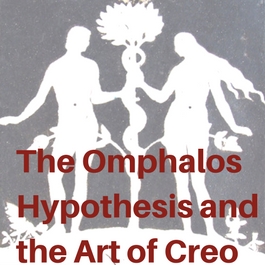
As always with philosophy episodes let’s start with defining terms. The Omphalos Hypothesis was defined in the late 19th Century by Phillip Gosse, but the same idea had cropped up for at least 1 500 years. It’s that at creation God placed evidence of false age into the world. We don’t need to plumb the depths of geology and palaeontology for this: let’s focus on Eden.
The thesis name is Greek for the belly button. Gosse stated that Adam must have had an umbilical scar, because he was created as an adult and adults have navels. Adam, to Gosse, did not arise from the dust hairless and without fingernails. This is less odd than it sounds. Gosse notes that the trees in the Garden had only been around for a day when they had fruit on them.
Hermetic magic creates items which are more perfect than natural objects. They are, technically, closer to the Realm of Forms. They contain only such accidents as are required for the object to exist, and to express the sigil of the magus. Magical towers, for example, are stronger than natural ones, because they are single pieces of stone, not two layers of ashlar bricks with gravel fill between. There are no faults in the stone unless this is required by the sigil, or it is definitional to the stone. Magical sandstone, for example, probably has a weaker direction, so it shears off in plates. Is sandstone without stripes really sandstone?
You might not agree with Gosse. When Gosse published this idea, it was widely hated, because it argued for a deceptive God that had coded a lie not just in the Eden story, but into the very bones of the Earth. God does not make lies, so the created thing has no accidental properties.
So, if your magus has an affinity, think through what scars, or accidents, you are assuming for the items that the character creates. If you make a horse, does it have a navel? If you make a wooden table, does it have grain, caused by growth rings? Does it have knots? If you make a beehive does it have larvae in it? Do things which are created by processes of aging, like wine and cheese, have the signs of aging, like dregs and rind? Grosse argued that yes, all created things would have accidents, because every object is just at one point in the cyclical processes of life, and needs to begin midcycle, but there were a lot of people who clearly didn’t agree.

